AI Prompt
1. Initial admissibility question (civil/criminal law) -
“In Australian Criminal Law, can evidence obtained by torture or under distress be used as evidence?”

2. Scope of “torture” vs PTSD and distress -
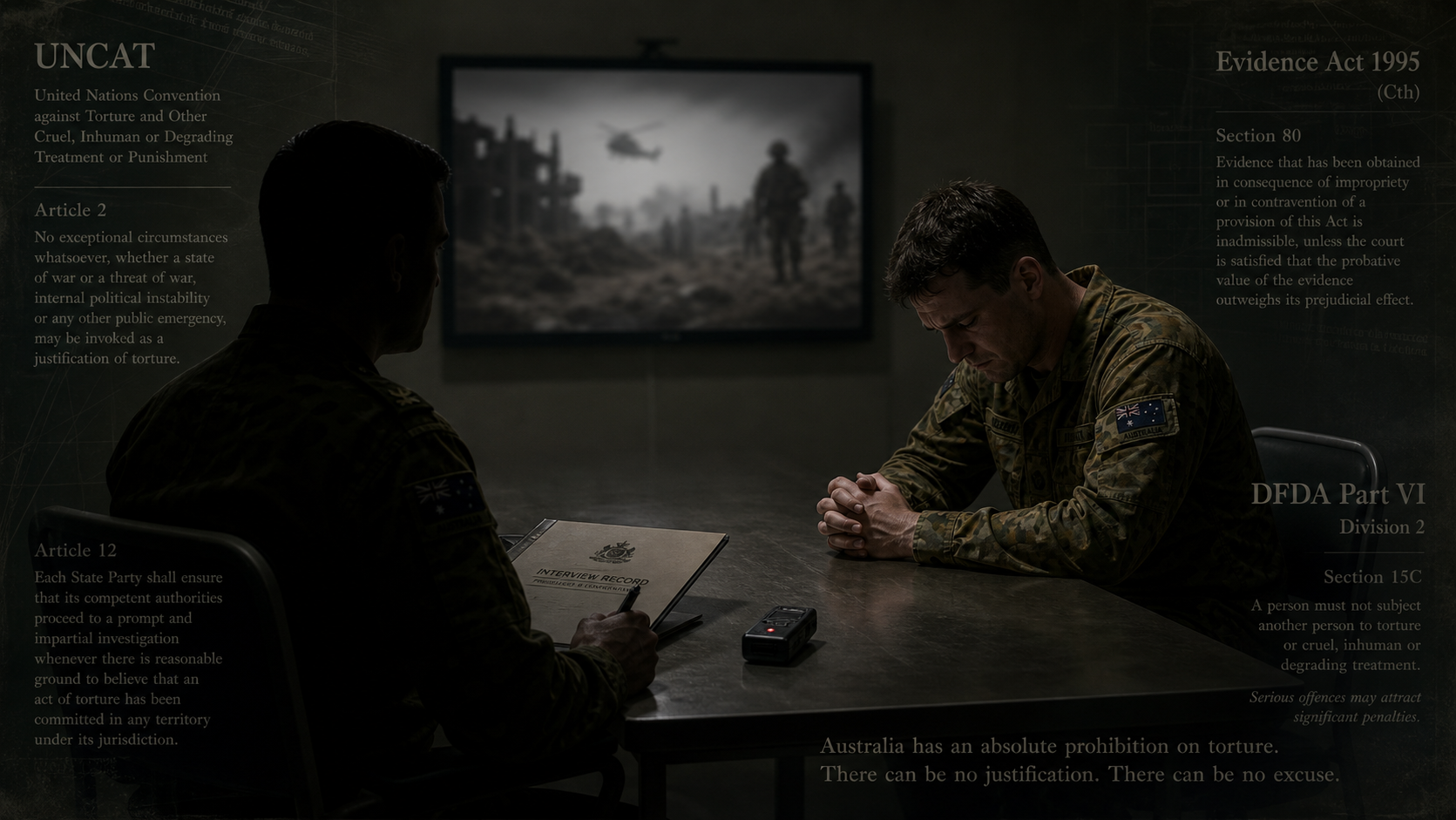
Next prompts explored whether invoking PTSD in a witness can be classed as torture under Australian law and medical definitions, and whether persistently showing mutilated/war‑ravaged images unrelated to an investigation could be torture by provoking PTSD.

3. Combined isolation + PTSD imagery as torture / illegal evidence -
I then asked whether isolating someone from professional support (doctors, solicitors, support persons, family/friends) and then using PTSD‑triggering imagery is a form of torture or an illegal practice of obtaining witness statements.

This prompted deeper work on coercive control, isolation as abuse, and the legal implications for admissibility, strengthening the basis for the report’s sections on isolation, PTSD exploitation, and evidentiary exclusion.

4. Request for an official report document -
With that context built, you asked: “With this chat history, now write an official report that outlines these findings, specifically citing primary source documents, including all Australian and International Law Definitions. Include an executive summary and embed source links into the PDF document.”

This was the key “meta‑prompt” that caused the creation of the full multi‑section report: international law (UNCAT), Australian criminal/evidence law, conceptual analysis of torture vs CIDT, and the evidentiary consequences.

5. Military‑specific mental degradation: identity and purpose stripping -
I then extended the scope: “In a military context add about intentionally taking away someone's identity and purpose as a form of mental degradation when they were not charged. Update the document and source this as well.”

That prompt led to adding Section 6 on military psychological torture techniques, including identity/purpose deprivation and depersonalization, drawing on sources about psychological torture, “white torture,” and military/RTI training practices.

6. ADF rules for military police / investigators questioning witnesses -
Next, I asked to: “cross reference the Australian Defense Force Guidelines, Legislation or Policies relating to what military police or military investigators can and cant do when questioning witnesses in the defense force. include the legislative or policy links in that assessment in the context of the rest of the report.”

That expanded the report into DFDA Part VI (Investigation of Service Offences), including ss.101E, 101H, 101J–K and 101ZB, plus the Defence Charter for Military Justice Proceedings and DI PERS 35‑4, so the report could compare civilian Evidence Act safeguards with ADF‑specific questioning and evidence‑exclusion rules.

7. IGADF reporting process for torture/mistreatment -
I then requested: “Add to the report what the official process of reporting torture if its conducted by IGADF.”

This prompt triggered research into the Inspector‑General ADF Regulation 2016, IGADF guidance on submissions, scope of matters (abuse of authority, denial of procedural fairness, cover‑up), whistle‑blower protections, and how an ADF member or family can report abuse or torture to IGADF.

8. Complaints when IGADF itself is implicated -
Finally, you asked: “specifically reference who does torture and complaints get referred to if it is a member of the IGADF committing the offense of trauma against witnesses. Add this as an additional flow on.”

That produced Section 10 on structural accountability: IGADF’s statutory reporting to the Minister, the role of the Defence Force Ombudsman as an external mechanism for allegations of abuse in Defence, and options for ministerial/parliamentary escalation when IGADF personnel themselves are alleged to have committed or concealed torture or mistreatment.
Research Context
Those prompts, in sequence, are what drove the report’s architecture: starting from admissibility of torture evidence in Australian criminal law, then layering PTSD and psychological torture, moving into military identity‑stripping and ADF investigative rules, and finally adding the IGADF/DFO reporting and accountability pathways to make the document operational in both civil and military contexts.