
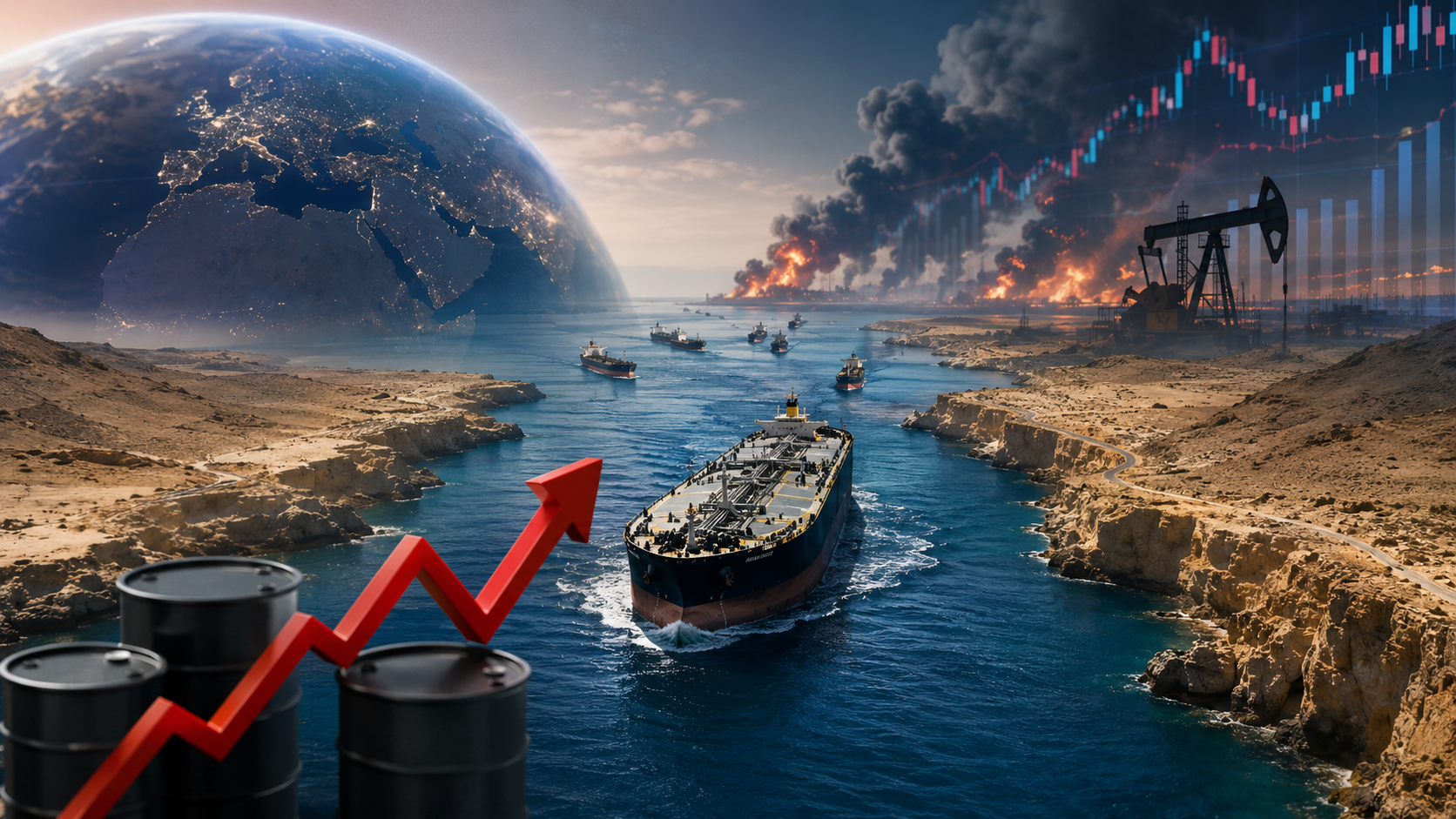
The Strait of Hormuz Crisis: A World Economy Under Siege
When the United States and Israel launched Operation Epic Fury against Iranian nuclear and leadership targets in late February 2026, few observers immediately grasped how a strike thousands of kilometers from most trading floors would ripple through household budgets from Jakarta to Johannesburg. Yet within days, the world's most consequential chokepoint — the Strait of Hormuz — had become a "no-go zone," and the global economy was thrust into its most severe energy shock since the 1970s oil embargo. This article explains why that narrow stretch of water matters so much, how the resulting oil price surge cascades into a worldwide economic shock, and why virtually no economy, rich or poor, has escaped its reach — all while a second energy-security crisis, the Ukraine-Russia war, continues to strain the same fragile system.
Why the Strait of Hormuz Matters So Much
The Strait of Hormuz is a narrow channel separating Iran from the Arabian Peninsula, connecting the oil-rich Persian Gulf to the open waters of the Gulf of Oman and, beyond that, the rest of the world. It is deep and wide enough to handle the largest crude tankers on Earth, and roughly 15 to 20 supertankers pass through it every single day, each carrying up to 2 million barrels of crude. In 2024, oil flow through the strait averaged about 20 million barrels per day, equivalent to roughly 20 percent of global petroleum liquids consumption, while other estimates put its share of maritime oil trade as high as a quarter to over a third of global seaborne crude.
What makes Hormuz uniquely dangerous to disrupt is the absence of alternatives. Very few pipeline routes exist to move Gulf oil to global markets without passing through the strait, meaning that any closure — even a partial or threatened one — creates supply delays and higher shipping costs almost instantly. Major buyers depend heavily on this route: more than a third of Hormuz-transiting crude was headed to China before the crisis, with India, South Korea, and Japan each receiving well over a million barrels a day through the same channel. When Iran began targeting vessels and effectively closed the waterway following the February strikes, roughly 90 to 95 percent of normal tanker traffic diverted or halted entirely, and Iraq cut oil production by 70 percent within two weeks while Saudi Arabia was forced to shut down a refinery.
How the Oil Price Surge Triggers a Worldwide Economic Shock
Energy is the lifeblood of virtually every other economic activity — manufacturing, transportation, agriculture, and heating all depend on it — so a spike in oil prices doesn't stay contained to gas stations. It works its way through the entire economy in layers. The initial shock came fast: Brent crude, which had been trading calmly near $60 to $69 a barrel in late 2025 and early 2026, surged more than 65 percent by late April, and various forecasts through the spring placed prices anywhere from $86 to above $110 a barrel, with some analysts even floating scenarios where prices could reach $200 if the conflict escalated further.
The transmission mechanism runs through three main channels. First, energy costs directly raise the price of fuel, transport, and electricity, which shows up almost immediately in headline inflation. The World Bank's Chief Economist Indermit Gill described this as the war hitting the global economy:
"in cumulative waves: first through higher energy prices, then higher food prices, and finally, higher inflation, which will push up interest rates and make debt even more expensive".
Second, because oil-derived products like fertilizer feed directly into agricultural costs, the shock spreads into food prices worldwide, worsening a cost-of-living crisis that was already stretching household budgets in many countries. Third, sustained high prices force central banks into an uncomfortable trade-off between fighting inflation with higher interest rates and protecting fragile growth — precisely the "stagflation" dynamic that policymakers dread.
The scale of these effects is not trivial. The IMF has calculated that a sustained 10 percent rise in energy prices over roughly a year can push global inflation up by about 40 basis points while cutting output by 0.1 to 0.2 percent. Gita Gopinath, the IMF's former chief economist, warned that if oil averages $85 a barrel for 2026, global growth could be shaved by 0.3 to 0.4 percentage points, with headline inflation rising by roughly 60 basis points. The OECD, in its own assessment released in June 2026, cut its global growth forecast to 2.8 percent for the year while projecting inflation across G20 economies to run well above earlier projections through 2027. The World Bank separately projected that global energy prices would surge 24 percent in 2026 — the sharpest jump since Russia's 2022 invasion of Ukraine — with overall commodity prices rising 16 percent, an initial oil supply reduction of about 10 million barrels per day, and Brent averaging $86 a barrel for the year, up sharply from $69 in 2025.
Financial markets reacted with textbook shock symptoms: equities fell, bond yields rose, currencies of oil-importing nations weakened, and emerging-market assets sold off broadly, even as US stocks later slipped from record highs once Brent climbed above $108 a barrel. This is the anatomy of a global energy shock — a single supply disruption that, through interconnected trade, inflation, and financial channels, touches nearly every corner of economic life.
Why No Country Is Immune
The most sobering feature of this crisis is how comprehensively it spreads, even though its effects are far from uniform. Research modeling the 2026 shock using global vector autoregression frameworks concluded plainly that "in a deeply interconnected world, no economy is insulated from large geopolitical shocks". The differences lie not in whether countries are affected, but in how and how badly.
Advanced economies that import most of their energy have felt it acutely. The European Commission's Spring 2026 Economic Outlook called the Hormuz closure "the most severe energy shock to hit Europe since the Russia-Ukraine conflict," revising its 2026 Brent forecast up 46 percent to an average of $91.2 a barrel. Eurozone growth projections were cut to 0.9 percent from 1.2 percent, while eurozone inflation forecasts rose to 3.0 percent and EU-wide inflation to 3.1 percent. Household energy bills across parts of Europe were already 14 percent higher in real terms compared with pre-Ukraine-war levels even before this new shock hit.
Emerging and developing economies, meanwhile, face a double bind. The World Bank projected that inflation in developing economies would average 5.1 percent in 2026 — a full percentage point higher than pre-war expectations — while their collective growth forecast was cut to 3.6 percent. Poorer households, who spend a far larger share of income on food and fuel, are hit hardest, and countries already carrying heavy debt burdens face compounding pressure as higher interest rates make that debt more expensive to service. Regions with thin strategic reserves are especially exposed: outside of China, most Asian economies hold less than two months of crude stock, while South Africa's buffer is closer to two weeks. Encouragingly, some analysis suggests emerging markets have so far weathered this shock somewhat better than in 2022, with inflation rising by an average of only 1.2 percentage points across a sample of 23 economies compared with 3.2 points during the earlier crisis, aided by more resilient currencies this time around.
Even the seemingly insulated United States isn't spared. As a net oil exporter with strong domestic production and heavy investment in artificial-intelligence-driven productivity, the US has absorbed the shock as merely "a modest headwind" according to Vanguard's senior economist Adam Schickling — but even that modest headwind could cost roughly 0.4 percentage points of growth if crude settles near $120 a barrel for a full year. Oil-exporting nations like Russia and Gulf states initially benefit from higher revenues, but that advantage tends to erode over time as weakened global demand for their other exports offsets the windfall, and the IMF has noted the war could still hinder growth even within the oil-rich Gulf Cooperation Council states themselves.
An Old Wound Reopened: The Ukraine-Russia Overlay
Crucially, this crisis is not unfolding in a vacuum — it is layering on top of an energy system still scarred by the Russia-Ukraine war. That earlier conflict already shrank Russia's economy by an estimated 5.5 percent and spurred a global energy crisis with lasting price surges. Nearly four years after Russia's invasion, emerging economies are now facing what analysts describe as a remarkably similar external shock — a spike in oil and gas prices layered onto supply disruption, this time from the Gulf rather than from Russia. European nations, in particular, spent years rewiring their energy supply chains away from Russian gas, only to now face the Hormuz shock as, in the European Commission's own words, the biggest energy blow since that invasion. British households alone spent an extra £605 on food between 2022 and 2023 compared with pre-war 2021, a direct consequence of the earlier gas crisis compounding climate-driven agricultural costs.
This overlapping timeline matters because it has eroded the buffers many economies would normally rely on to absorb a fresh shock. Central banks that spent years tightening policy to tame Ukraine-war-era inflation now have less room to maneuver, and global oil inventories — already thinned by years of volatility — are running dangerously low, with analysts warning that a further price spike could still materialize if a deal to reopen Hormuz tanker traffic remains elusive. Some easing has occurred: a partial oversupply expected from non-sanctioned Russian barrels searching for buyers had been projected to push oil prices lower heading into 2026, before the Iran conflict abruptly reversed that trajectory. The net effect is a global economy absorbing two overlapping energy shocks within a four-year span, leaving less room for error and higher stakes for however the current crisis resolves.
The Bottom Line
The Strait of Hormuz crisis demonstrates, in real time, how a single geopolitical flashpoint in one of the world's narrowest waterways can ripple outward into inflation, slower growth, and financial market stress across every region on Earth. Analysts broadly agree that the duration of the disruption — not just its initial severity — will determine whether this settles into a manageable bump or hardens into a lasting stagflationary drag, particularly as the world still carries the unresolved scars of the Ukraine-Russia war.